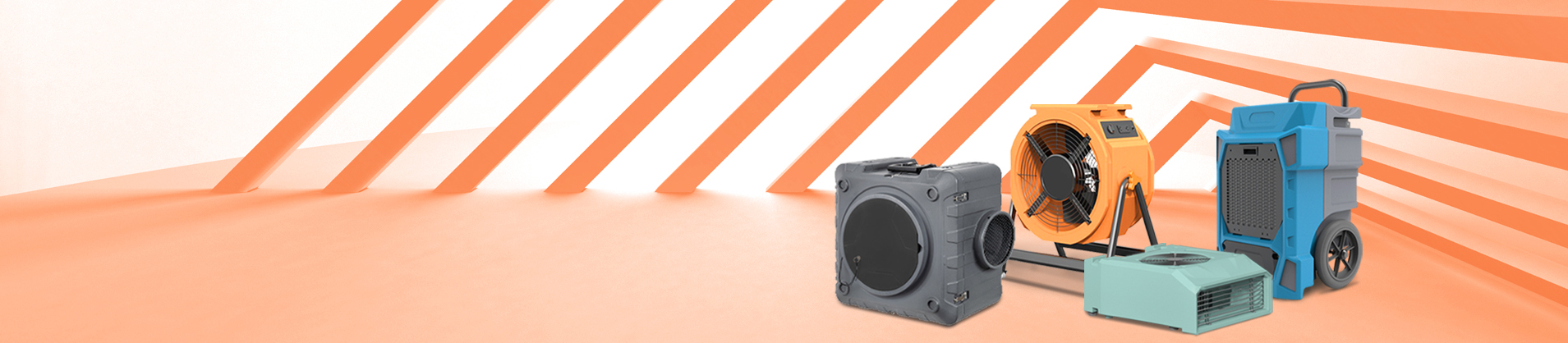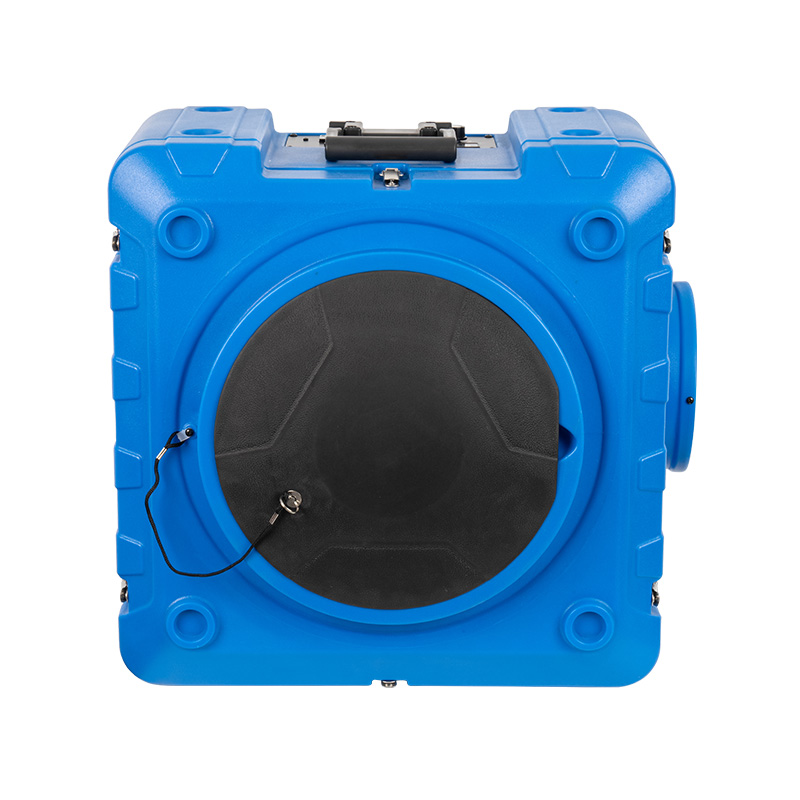
An air mover is a high-velocity, motor-driven fan built to speed up evaporation from wet surfaces such as carpet, drywall, hardwood, and concrete. Unlike a household fan that scatters air in every direction, an air mover concentrates its output into a focused, directional stream — typically 600 to 4,000+ cubic feet per minute (CFM) — that sweeps moisture-laden air off a surface so a dehumidifier can pull it out of the room. A flat air mover (also called a low-profile or thin-profile air mover) is a specific style built to slide under cabinets, counters, and raised furniture where a standard upright unit won't fit.
This article breaks down how air movers work, the difference between flat air movers and other designs, how to size CFM to a room, and how to place units correctly so drying time stays as short as possible.
An air mover works on a simple principle: moving air across a wet surface breaks up the thin layer of saturated air sitting right above it, replacing it with drier air that can absorb more moisture. This constant exchange accelerates evaporation far faster than still air ever could. The moisture doesn't disappear — it moves from the surface into the air, which is why air movers are almost always paired with a dehumidifier that then extracts that moisture from the room.
Inside the housing, a motor spins a fan wheel — either axial (blades parallel to airflow) or centrifugal (blades perpendicular to airflow) — that draws air in through an intake and forces it out through a shaped nozzle. That shaping is what separates an air mover from a box fan: the output is compressed into a narrow, high-speed stream instead of a broad, low-speed breeze.
Most units draw 3 to 5 amps at 120 volts, which matters on job sites because a standard 15-amp household circuit can safely run only two to three air movers before tripping a breaker.
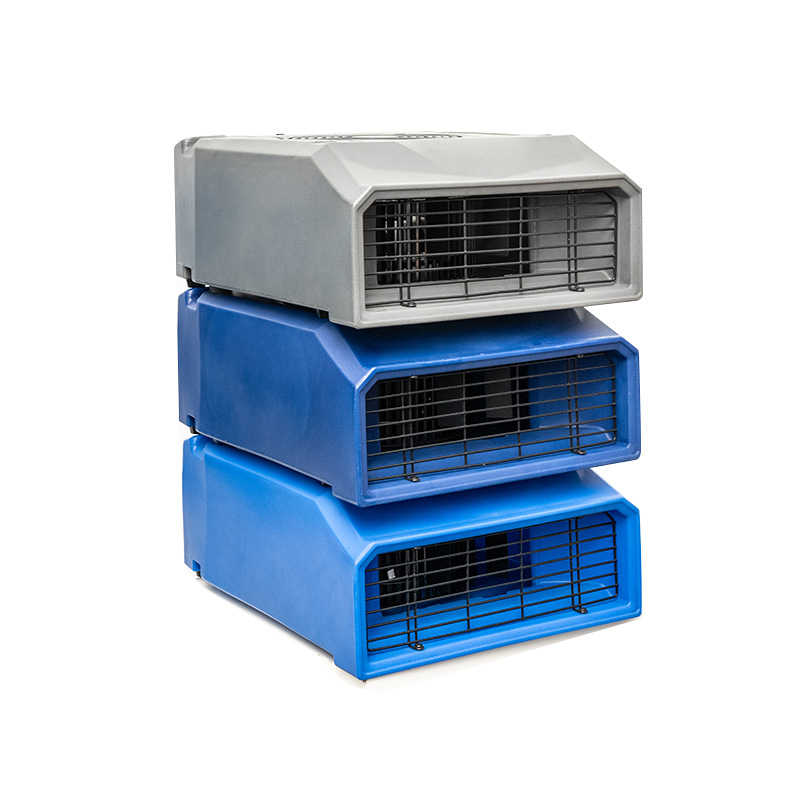
A flat air mover, often marketed as a low-profile or thin-profile air mover, is a compact design that stands roughly half the height of a standard centrifugal unit, with many models measuring close to 10 to 11 inches tall. That reduced height lets the unit slide into spaces a standard air mover physically cannot reach: under kitchen cabinets, beneath raised furniture, inside crawlspaces, and along baseboard cavities.
Rather than pushing air straight up, a flat air mover releases a wide, shallow stream that runs parallel to the floor. This keeps airflow sheared directly across the wet surface without needing to lift carpet or move furniture, which is why the design is standard on Category 1 clean-water drying jobs where speed and minimal disruption both matter.
| Specification | Typical Range |
|---|---|
| Airflow output | 800 to 1,700 CFM |
| Motor size | 1/5 HP to 1/4 HP |
| Amp draw | 2.0 to 2.8 amps |
| Unit height | Approximately 10 to 11 inches |
| Weight | 22 to 24 lbs |
| Stackable capacity | Up to 10 units |
Look for a built-in GFCI outlet for daisy-chaining multiple units off one circuit, a carpet clamp for drying without pulling carpet up, and an unbreakable roto-molded housing, since flat units get slid in and out of tight spots constantly and take more physical abuse than upright models.
Both designs move large volumes of focused air, but they solve different placement problems. A standard centrifugal or axial air mover stands upright and directs air outward from chest or knee height, making it the better choice for open-floor drying, wall drying, and general room ventilation. A flat air mover trades some raw airflow for the ability to fit where an upright unit cannot go.
| Feature | Standard Air Mover | Flat Air Mover |
|---|---|---|
| Typical CFM | 1,500 to 3,600 CFM | 800 to 1,700 CFM |
| Height | 18 to 24 inches | 10 to 11 inches |
| Best for | Open floors, walls, ceilings, large rooms | Under cabinets, crawlspaces, baseboards |
| Airflow direction | Angled, outward stream | Wide, shallow, parallel to floor |
| Noise level | Moderate to high | Generally quieter |
On most restoration jobs, the two designs work together rather than as a substitute for one another: flat air movers handle the tight, low-clearance spots while standard units cover the open floor area.
CFM requirements scale with room size and the severity of the moisture. As a general guideline, residential rooms typically need 1,000 to 2,000 CFM of total airflow, while commercial spaces often require 2,000 to 3,000+ CFM, achieved either with a single high-output unit or multiple standard units working together.
The IICRC S500 standard, the industry reference for water damage restoration, also ties unit count to wall length rather than just square footage: as a working rule, add one air mover for every 10 to 16 linear feet of wet wall, plus an additional unit for each wall inset or offset larger than 18 inches. Following this formula helps ensure no wet section is left without direct airflow.
Placement affects drying speed as much as CFM rating does. A powerful unit aimed incorrectly will dry slower than a smaller unit placed well. The following placement rules are drawn from standard restoration practice and apply to both flat and standard air movers.
For a spot on a wall or ceiling, adjust the unit's angle so the airstream reaches that exact area rather than relying on general circulation to eventually dry it. Leaving air movers running unattended for extended periods without checking progress is one of the most common reasons restoration jobs take longer than they should.
Water damage restoration is the primary use case, but air movers, including flat models, are common equipment well outside that industry.
In each of these cases, the same principle applies: focused, high-velocity airflow moves moisture or stale air away faster than passive ventilation alone.
Beyond the CFM rating, a handful of build-quality features determine how well a unit performs over repeated use.
Professional-grade units generally cost more upfront but hold up to daily transport and continuous runtime far longer than consumer-grade fans, which lowers the effective cost per job over time.
3段階濾過:エアスクラバーは、プレフィルター(MERV-10)、カーボンフィルター、H13 HEPAフィルターを含む3段階濾過システムを備えています。 0.3ミクロンもの小さな粒子を99.97%捕らえながら、ほこり、花粉、煙、臭いを効果的に除去します。これにより室内の空気の質がすぐに改善され、より快適な生活環境が生まれます。 ユーザーフレンドリーなコントロールパネル:コントロールパネル...
詳細を見る
AM-B01 大風量薄型カーペット乾燥機は、強力なモーターを搭載しており、大風量でカーペットを素早くしっかり乾燥させます。この高い空気量は湿気の蒸発を促進するだけでなく、カーペットの繊維の奥深くまで浸透し、湿気の余地を残しません。洗練されたコンパクトなこれらのマシンは、狭いスペースにも簡単に収まり、カーペットの特定の領域を効果的にターゲットにできます。スリムなデザインにより、ユニットを使用し...
詳細を見る
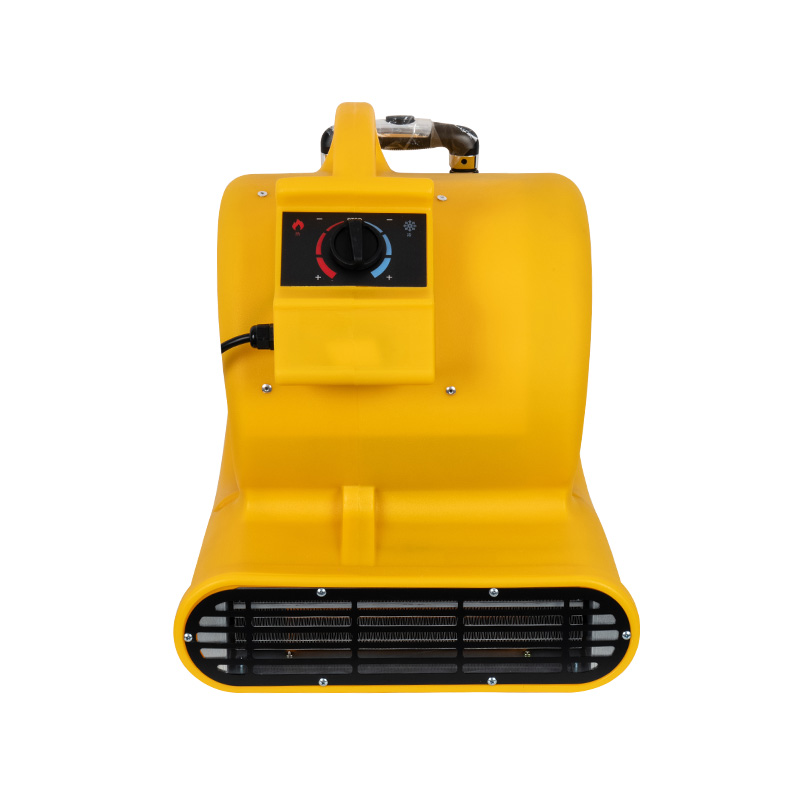
AM-A01 ホットおよびコールド カーペット乾燥ファンは、温風と冷気を利用してカーペットの乾燥プロセスを高速化するように設計された多用途ユニットです。熱気と冷気の循環の利点を組み合わせたこれらの革新的なファンには、大量の空気を生成する強力なモーターが装備されており、熱気または冷気がカーペットの表面に均一に分配されます。この包括的な空気の流れは、乾燥プロセスをスピードアップするだけでなく、カ...
詳細を見る
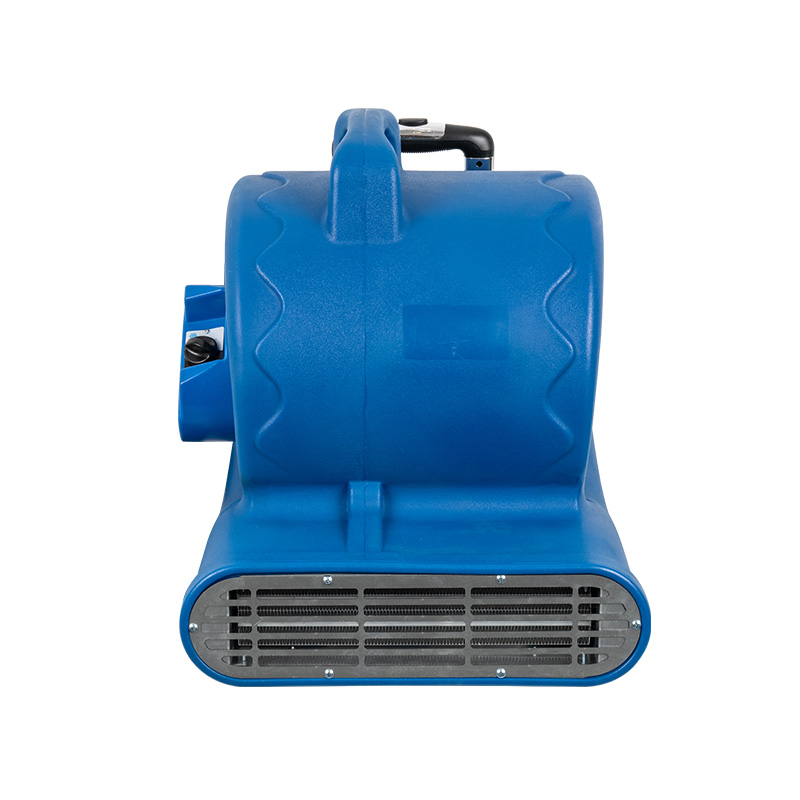
AM-A02 マルチウィング遠心風車カーペット乾燥機は、マルチウィング遠心風車技術の使用により、風力と気流を効果的に増加させ、より速くより効率的にカーペットを乾燥させます。複数のエアブレードを注意深く配置することで、遠心風力ホイールは高速回転で強力な気流を生成できます。この設計により、ファンの効率が向上するだけでなく、空気の流れも増加し、より広範囲のカーペット表面が均等な風力でカバーされるよ...
詳細を見る
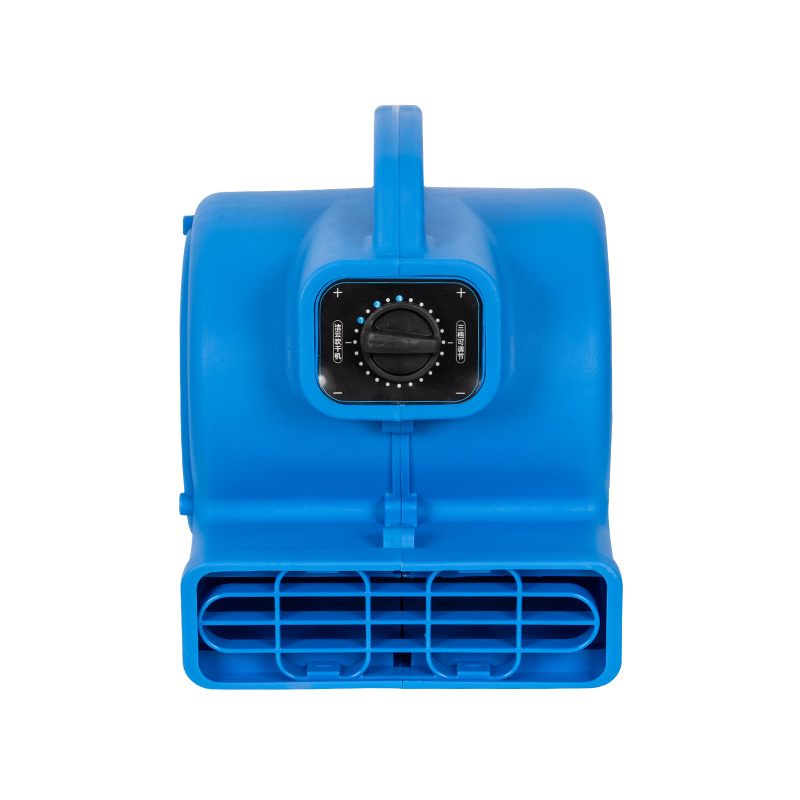
AM-A03 小型アキシャル フロア カーペット ドライヤーは、表面をより速く乾燥させるための遠心送風機を備えた、高効率で多用途の乾燥ユニットです。カーペット、床、家具、窓、壁の乾燥に適しているだけでなく、換気装置としても機能し、室内の空気循環を高めます。この製品は 3 つの速度と 3 つの操作位置 (0°、20°、90°) で独自に設計されており、さまざまな乾燥ニーズのシナリオに適していま...
詳細を見る
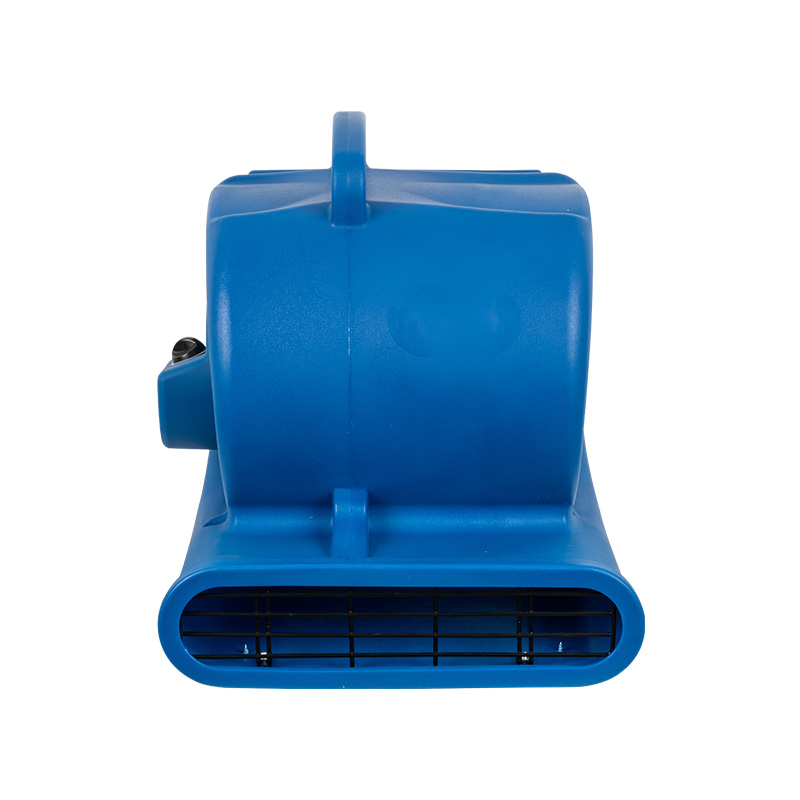
AM-A04 軽量ポータブル カーペット ウォール フロア ドライヤーは、高度な遠心空気移動技術を備えており、より迅速な表面乾燥を実現します。カーペット、床、家具、窓、壁などの幅広い乾燥作業に適しているだけでなく、換気して室内の空気循環を高めるように特別に設計されています。 AM-A04 床乾燥機は 3 つの速度と 3 つの動作位置 (0°、20°、90°) を備えており、さまざまな環...
詳細を見る店舗情報
中国浙江省紹興市盛州市三江街岳新路88号
+86-13819532379
リンク
製品
モバイル端末